

MAX2000® Progressive Cavity Pumps
Unmatched Reliability, Unrivaled Performance
The MAX2000® Progressing Cavity Pumps feature highly reliable pumping characteristics that allow the user to monitor fluid rates with precision in applications from environmental remediation to food service industries.
Applications
Ideal for a myriad of industrial uses, from environmental remediation to the food service industry, our MAX2000® Progressing Cavity Pumps stand as a testament to reliability and efficiency.
Progressive Cavity Pumps for Sale
Invest in the reliability and performance of MAX2000® Progressing Cavity Pumps for your oil & gas industrial needs.

Double-Seal Pin Joint
Eliminates contamination risks
Modular Design
Easily adjustable pumping characteristics
Extended Unit Life
Minimized downtime with rugged maintenance parts
Skid-Mounted
Effortless transport and setup
FEATURES
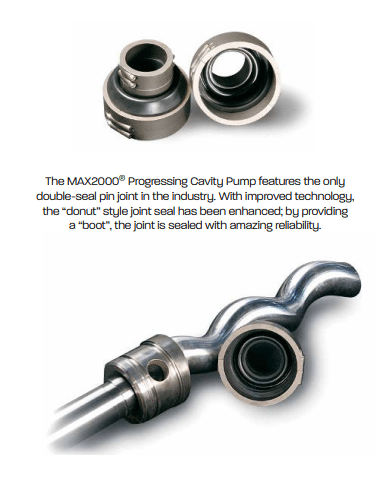
- The MAX2000® Progressing Cavity Pump features the only double-seal pin joint in the industry. With improved technology, the “donut” style joint seal has been enhanced. By providing a “boot”, the joint is sealed with amazing reliability. When installed correctly, the boot clamps compress the boot to seal each joint with more than one inch of linear sealed surfaces. This greatly minimizes the potential for contamination of the joint.
- As with centrifugal pumps, we have created a modular design in the MAX2000® Progressing Cavity Pump. This modular design minimizes the need for customers to stock a wide variety of components. In doing so, it is now very easy to change the pumping elements, and alter the pumping characteristic of the MAX2000® Progressing Cavity Pump.
- Unlike most progressive cavity pumps sold in the United States, approximately 98% of the components in our MAX2000® Progressing Cavity Pumps are manufactured in the United States by craftsmen who take great pride in their workmanship.
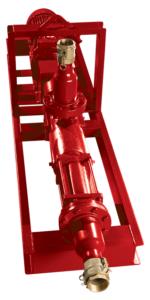

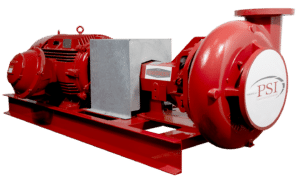
Progressive Cavity Pump Applications
Here is how our progressive cavity pumps for oil field, wastewater, and industrial customers put that reliability to work.
Oil & Gas Drilling
Operators and rig contractors rely on PSI progressive cavity pumps for drilling mud transfer, mud tank agitation support, and well cementing operations. Our progressive cavity pump for oil field use handles high viscosity drilling fluid, weighted mud, and abrasive solids without losing consistent output, which keeps solids control equipment running smoothly on location.
Municipal & Wastewater Treatment
Water and wastewater operators use PSI progressive cavity pumps for wastewater to move sludge, grit, and biosolids through treatment stages. The sealed cavity design meters flow accurately even as solids content and viscosity change from one stage of the plant to the next.
Mining & Mineral Processing
Mining companies use our progressive cavity pump for mining operations to transfer slurry, tailings, and dewatering discharge. The pump’s low shear action protects mineral particle structure while still handling heavy, abrasive material.
Chemical & Industrial Processing
Process plants choose PSI progressive cavity pumps for processing plants where corrosive, viscous, or shear sensitive chemicals need dependable, pulse free metering. Material options and mechanical seal choices are matched to the chemical being handled.
Construction Dewatering
On job sites where groundwater carries mud, silt, or debris, PSI progressive cavity pumps provide controlled, high capacity dewatering that standard centrifugal pumps cannot match once solids content rises.
How a Progressive Cavity Pump Works
A progressive cavity pump moves fluid using a single helical metal rotor turning inside a double helix elastomer stator. As the rotor turns, it forms a series of sealed cavities that carry fluid from the suction side to the discharge side at a steady rate. Because the cavities are sealed, flow stays consistent even when discharge pressure changes, and the pump can prime itself and handle air, solids, and gas mixed into the fluid stream.
PSI’s MAX2000® design adds one advantage no other manufacturer offers: the industry’s first double seal pin joint. A donut style joint seal, reinforced with a boot, keeps contamination out of the joint and extends the working life of the connection between the rotor and drive shaft.
MAX2000® Progressive Cavity Pump Specifications
PSI manufactures four progressive cavity pump models to match a wide range of flow and pressure requirements. All performance figures below are based on water at 70°F and rotor/stator geometry published in PSI’s MAX2000® performance charts.
| Model | Max Flow (GPM) | Max Horsepower | Tested Pressure Range |
Speed Range (RPM)
|
| MAX2000® 60 | Up to 150 GPM | Up to 30 HP | 30, 60, 90 PSI | 100 to 700 RPM |
| MAX2000® 70 | Up to 250 GPM | Up to 25 HP | 30, 60, 90 PSI | 100 to 700 RPM |
| MAX2000® 80 | Up to 350 GPM | Up to 140 HP | 30, 60, 90 PSI | 100 to 700 RPM |
| MAX2000® 90 | Up to 500 GPM | Up to 80 HP | 30, 60, 90 PSI | 100 to 700 RPM |
| Feature | Detail |
| Joint Design | Industry exclusive double seal pin joint with boot style seal |
| Drive Options | Inverter or mechanical speed drives, electrical starters available on request |
| Shaft Sealing | Soft gland packing or mechanical seal option |
| Mounting | Rugged skid mounted for easy transport and setup |
| Certifications | UL and ATEX certified, manufactured under ISO 9001 |
| Manufacturing Origin | Made in the USA in Houston, Texas |
Need a specific GPM or PSI figure for your application?
Product Categories

Industrial Pumps
Industrial pumps move liquids and slurries for various applications in water treatment, wastewater management, food processing, manufacturing, factories, plants, and worksites.
Material Handling Equipment
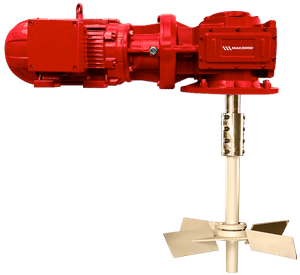
This category includes three essential products that cater to various material handling needs: the MAX2000 Mud Agitators, Screw Conveyors, and High Shear Hoppers.
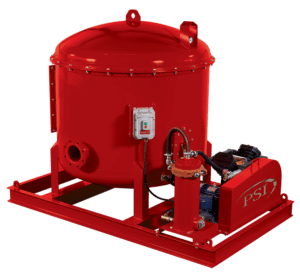
Gas Management Systems
Gas management systems are vital for controlling the entrained gasses during these operations. Here’s a closer look at some of the top systems in this category.
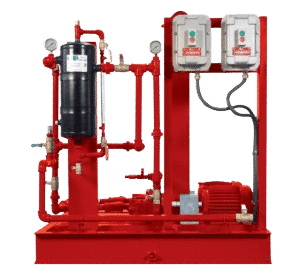
Fuel Filtration Systems
Our range of fuel filtration systems is designed to enhance and simplify your operations, saving you time and costs and ensuring a cleaner and safer working environment.
Progressive Cavity Pump vs. Centrifugal Pump
| Progressive Cavity Pump | Centrifugal Pump | |
| Fluid Type | Thick, abrasive, viscous, solids laden | Thin, low viscosity, water like fluids |
| Flow Behavior | Constant flow regardless of pressure changes | Flow drops as discharge pressure rises |
| Best For | Drilling mud, sludge, slurry, pastes | High volume water transfer |
| Shear Sensitivity | Low shear, gentle on product | Higher shear at the impeller |
As a general rule, when the required pressure in PSI is higher than the required flow in GPM, a progressive cavity pump is usually the better fit. When flow needs are high and pressure needs are modest, PSI’s MAKDADDY® centrifugal pumps are often the right choice instead.
FAQs
What is a progressive cavity pump used for?
A progressive cavity pump is used to move thick, abrasive, viscous, or shear sensitive fluids that standard pumps cannot handle well. Common uses include drilling mud transfer, wastewater sludge, mining slurry, and industrial chemical processing.
How does a progressive cavity pump work?
A single helical rotor turns inside a double helix elastomer stator, forming sealed cavities that carry fluid from suction to discharge. This keeps flow steady even when pressure conditions change.
What is the difference between a progressive cavity pump and a centrifugal pump?
A progressive cavity pump is a positive displacement pump that holds a steady flow rate even as pressure changes, making it ideal for thick or abrasive fluids. A centrifugal pump works best on thinner, water like fluids and loses efficiency as viscosity rises.
What fluids can a MAX2000 progressive cavity pump handle?
PSI's progressive cavity pumps handle abrasive, fragile, viscous, corrosive, and hot or heavy products, including drilling mud, sludge, slurry, and process chemicals.
What makes PSI's progressive cavity pump different from other manufacturers?
PSI's MAX2000 pump features the industry's only double seal pin joint, which virtually eliminates contamination at the joint. The pump is also modular for quick field maintenance.
How do you maintain a progressive cavity pump?
Never run the pump dry, since even a few seconds without fluid can damage the stator. Check for wear on a regular schedule, keep the pin joint properly sealed, and replace worn components early to avoid unplanned downtime.
Can a progressive cavity pump be used for oilfield drilling mud transfer?
Yes. PSI progressive cavity pumps are widely used for drilling fluid transfer on oilfield rigs, where consistent flow and abrasion resistance are critical for solids control operations.