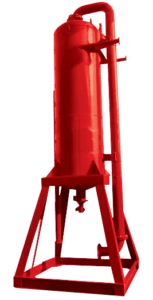
Mud Gas Separators
PSI’s Mud Gas Separators are essential for safely venting large pockets of free gas from drilling fluids during high-risk operations.
Engineered to handle hazardous gases, including methane, H2S, and CO2. PSI’s separators are built for robust performance with:
- Corrosion-resistant construction for long-term durability in harsh oilfield environments
- Skid-mounted design for easy placement and transport between locations
- Full gas management system compatibility — pair with PSI’s vacuum degassers and atmospheric degassers for comprehensive drilling fluid gas removal
When paired with our full line of gas management systems, PSI’s Mud Gas Separators deliver comprehensive and reliable solutions for efficient and safe drilling fluid management.
Mud Gas Separators: Industries We Serve
Mud Gas Separators are used wherever drilling fluid gas management and well control are required.
Onshore Drilling: Well Control Equipment
On land drilling rigs, the mud gas separator is positioned between the choke manifold and the active mud system. During a gas kick or well control event, gas-cut mud is diverted through the separator before returning to the pit. PSI’s skid-mounted poor boy degassers are sized and configured for land rig choke manifold installations across the Permian Basin, Eagle Ford, Haynesville, and other active U.S. onshore plays. PSI serves operators and rig contractors worldwide.
Deepwater & High-Pressure Well Control
High-pressure well control situations generate large gas slugs that exceed the capacity of standard vacuum degassers. PSI mud gas separators are specifically engineered for these high-flow, high-volume free gas events. The gravity separation vessel handles large-pocket gas entry from the choke line, separating gas from drilling fluid efficiently before the fluid returns to the active circulating system. Custom pressure ratings and vessel volumes available for HPHT well programs.
Offshore Drilling: Gas Liquid Separator Systems
Offshore platforms and jackup rigs require gas-liquid separator equipment rated for marine environments and hazardous area classifications. PSI mud gas separators are available with hot-dip galvanized construction for offshore corrosion resistance, ATEX/IECEx-rated components, and custom skid layouts to fit platform deck space constraints. H2S-rated construction is available for sour gas offshore wells where hydrogen sulfide concentrations require special materials.
International Oilfield Drilling Mud Degassing
PSI has supplied mud gas separators and drilling mud degassing equipment to oilfield operations in Saudi Arabia, the GCC, and South America. Units are available with international documentation packages, NACE compliance for sour service, and ATEX/IECEx hazardous area ratings for national oil company and EPC contractor procurement requirements. As an ISO 9001:2015 certified oilfield equipment manufacturer, PSI supports international quality management system requirements for well control and gas management equipment supply.

VAK 500®/1000®/1200® Vacuum Degassers
The VAK Degasser robustly removes 99.9% of entrained air and gases like methane from drilling fluids, powered by an industrial-grade motor. This self-contained, skid-mounted unit efficiently manages high-viscosity fluids, offering up to 29″ Hg of vacuum.

Atmospheric Degassers
The PSI Atmospheric Degasser efficiently removes entrained gases from drilling fluid using a 10 HP motor and a unique separation tank technique. Available in two models to accommodate different pit depths, these compact units are made of high-quality steel and feature explosion-proof components, ensuring safe and durable operation.

Mud Gas Separators
Mud gas separators are devices used to separate and safely vent large pockets of free gas from the drilling fluids in well-drilling operations. They prevent gas blowouts and ensure safe and continuous drilling.
Mud Gas Separators Major Users
Mud Gas Separators are used wherever drilling fluid gas management and well control are required.
Oil & Gas Drilling Operators
Upstream operators managing active drilling programs source mud gas separators as required well control equipment on every rig. PSI supplies operators running land, offshore, and directional wells who need reliable poor boy degassers with fast lead times, H2S service options, and same-day parts availability. PSI’s ISO 9001:2015 certification meets operator quality management system requirements.
Oilfield Services Companies & Rig Contractors
Oilfield services companies and drilling contractors maintaining rig equipment inventories purchase mud gas separators and gas busters in volume, requiring consistent supply, standardized configurations, and documented quality. PSI supports bulk supply for rig fleets across the Permian Basin, Gulf Coast, and international markets. Replacement parts, dimensional drawings, and technical documentation available on request.
EPC Contractors & Engineering Firms
Engineering, procurement, and construction (EPC) contractors spec-ing mud gas separator and drilling fluid gas management equipment for greenfield rig builds and brownfield upgrades require ISO-certified manufacturers, full documentation packages, and custom engineering to project specifications. PSI provides GA drawings, BOMs, material certificates, and NACE/ATEX compliance documentation for engineering packages.
Equipment Dealers & Distributors
Oilfield equipment dealers and distributors in Texas, the Gulf Coast, and international markets source PSI mud gas separators for resale to drilling operators and rig contractors. PSI offers competitive lead times, OEM documentation, and consistent product quality backed by ISO 9001:2015 certification. Contact PSI at (281) 893-4774 to discuss distributor and dealer arrangements.
Middle East & International NOC Procurement
National oil companies (NOCs), Aramco-approved vendors, and international oilfield procurement teams sourcing mud gas separator manufacturer GCC supply require ISO 9001:2015 certification, ATEX/IECEx ratings, NACE sour service compliance, and full material traceability. PSI has an established supply history to the Middle East and can provide vendor qualification documentation, ITP packages, and international freight on request.
Product Categories

Industrial Pumps
Industrial pumps move liquids and slurries for various applications in water treatment, wastewater management, food processing, manufacturing, factories, plants, and worksites.
Material Handling Equipment
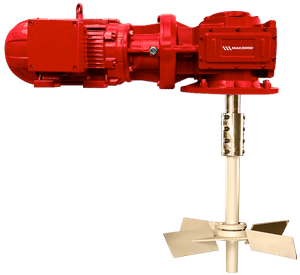
This category includes three essential products that cater to various material handling needs: the MAX2000 Mud Agitators, Screw Conveyors, and High Shear Hoppers.
Gas Management Systems
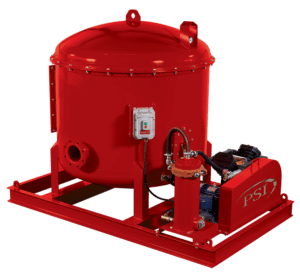
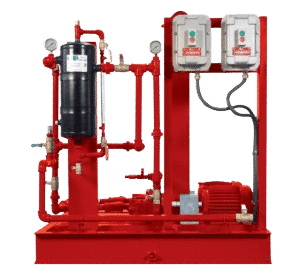
Gas management systems are vital for controlling the entrained gasses during these operations. Here’s a closer look at some of the top systems in this category.
Fuel Filtration Systems
Our range of fuel filtration systems is designed to enhance and simplify your operations, saving you time and costs and ensuring a cleaner and safer working environment.
FAQs
What gases do PSI mud gas separators handle?
PSI mud gas separators are engineered to handle methane, hydrogen sulfide (H2S), carbon dioxide (CO2), and mixed gas streams typical in oil and gas drilling operations. H2S-rated construction with NACE-compliant materials is available for sour service wells where hydrogen sulfide concentrations exceed safe limits for standard carbon steel. Contact PSI at (281) 893-4774 to discuss H2S service requirements for your well program.
Is a mud gas separator required on every drilling rig?
Yes. In most jurisdictions and under most operator and regulatory requirements, a mud gas separator is required to control equipment on every active drilling rig. API RP 92L and API RP 49 reference mud gas separator requirements for land drilling, and offshore regulations under BSEE and equivalent international bodies also mandate gas separation equipment as part of the well control system. PSI mud gas separators are supplied to meet these requirements.
What is drilling mud degassing and when is it required?
Drilling mud degassing refers to the process of removing gas from drilling fluid before it is recirculated downhole. Gas-cut mud has a lower density than designed, which can cause loss of hydrostatic pressure control and increase blowout risk. Degassing equipment, including mud gas separators, atmospheric degassers, and vacuum degassers, and each play different roles in this process. The mud gas separator handles large gas slugs during well control events; atmospheric and vacuum degassers handle continuous entrained gas removal during normal drilling. PSI manufactures all three types as part of a complete industrial gas management system.
Who manufactures PSI mud gas separators?
PSI mud gas separators are manufactured by Process Solutions International, an ISO 9001:2015 certified oilfield equipment manufacturer based in Houston, TX, operating since 1991. PSI is a full-range drilling fluid handling equipment and gas management system manufacturer supplying operators, oilfield services companies, EPC contractors, and equipment distributors across the U.S., Middle East, and South America. Address: 7519 Prairie Oak Drive, Houston, TX 77086. Phone: (281) 893-4774. Email: info@psimax2000.com.
What is the difference between a mud gas separator and a vacuum degasser?
A mud gas separator handles large volumes of free gas during a well control event or gas kick. It is a well control device designed for high-gas-volume situations. A vacuum degasser removes small amounts of entrained dissolved gas from drilling fluid during normal circulation using vacuum technology. Most complete drilling fluid systems require both: the mud gas separator for well control events and the vacuum degasser for continuous gas removal during routine drilling operations. PSI manufactures both; visit the vAK vacuum degasser page for details.